Our Governance Model
HUMA™
Keep accountability human.
Human-Centered Unified Model for AI Governance
HUMA™ is Regavon's method for keeping humans accountable for AI: who owns it, what it may decide, how it is overseen, and the evidence that governance happened. It connects people, AI use cases, systems, risk, decision authority, controls and evidence into one governance model — with human accountability at the center.
See how HUMA works
One accountable record for every AI system.
In 100 seconds: how HUMA™ takes an AI system from registration to human oversight and evidence — and keeps its governance record current as the AI changes.
Product in development. Interface shown with synthetic data.

Read the transcript
AI is moving faster than the organizations using it. Decisions about hiring, lending, and people are being shaped by systems most leaders can't fully see. The question is no longer whether to use AI. It's who is accountable when it acts. That's why we built HUMA. H: Human-Centered Leadership. U: Understanding Risk. M: Managing AI Responsibly. A: Accountability and Governance. Four pillars that keep humanity at the center of every AI decision. Regavon is building the HUMA Command Center: one place to see every AI system in your organization, who owns it, how risky it is, and whether the evidence is there to prove it's governed. Register and tier every AI system. Track open findings and evidence. Measure readiness against NIST AI RMF, ISO 42001, the EU AI Act and the Colorado AI Act. And get one clear HUMA Score your board can understand. When someone asks, 'Who is accountable for this system, and where's the evidence?', you have the answer in seconds. Clear decision rights. Ethics review. A human in the loop, always. HUMA Command Center is in development now. Built for organizations in highly regulated environments that want to move fast without losing trust. Because artificial intelligence should expand human potential, not diminish human value.
HUMA Overview
A structured way to see AI risk.
Overview
HUMA is Regavon's AI governance framework, applied to how organizations evaluate AI risk — including in financial institutions and M&A diligence. It gives a structured way to map AI systems, classify risk, and assess workforce impact.
How It Works
The HUMA Framework (Human-Centered Leadership, Understanding Risk, Managing AI Responsibly, Accountability & Governance) maps AI systems against a maturity and risk-classification model, informed by Regavon's control library and workforce decision-rights methodology.
What It Delivers
A clearer view of AI risk exposure across vendors and internal systems. Documentation aligned to NIST AI RMF and EU AI Act. Workforce AI impact findings. Structured reporting for diligence contexts.
Why We Built It
Regavon is an AI governance technology company founded by Yuri Maia. Most organizations deploying AI don't yet have a structured way to show it's governed responsibly. HUMA is one attempt to close that gap.
HUMA Score — self-assessment
A free tool to see where your AI governance stands. Available now.
Learn more →Govern the system around AI.
AI governance is more than governing a model. HUMA™ establishes what AI is being used for, who owns the use case, how risk is classified, what AI may decide, where human authority is required, what controls apply and what evidence demonstrates those controls are operating.
The Six Components of HUMA™
One system for operational AI governance.
01
Humans
Keep people visible in the system.
Identify who uses AI, who is affected by it, who reviews its outputs and who remains accountable for resulting decisions.
02
Use Cases
Govern what AI is actually doing.
Define the business purpose, decision context, affected stakeholders and consequences of each AI use case.
03
AI Systems
Know what enables the use case.
Identify relevant models, applications, vendors, data dependencies and supporting technologies.
04
Risk & Decision Rights
Match authority to risk.
Classify risk and establish what AI may do, what requires human review and who has authority to approve, intervene, escalate or override.
05
Controls & Evidence
Make governance demonstrable.
Translate governance requirements into controls, accountable owners, documentation and evidence that demonstrate those controls are operating.
06
Continuous Governance
Govern as AI changes.
Monitor changes, incidents, control performance, emerging risks and external requirements and reassess governance when necessary.
HUMA™ Application
Workforce Decision Rights
Human oversight, defined as authority.
“Human oversight” is often treated as a principle. HUMA™ turns it into a governance decision. For each workforce AI use case, organizations define how much decision authority AI may exercise and where human authority must remain.
AI can augment decisions. Accountability remains human.
- A0Human onlyAI is not permitted for this decision.
- A1AI informsAI provides information; a person decides.
- A2AI recommendsAI proposes; a person decides and records whether they followed it.
- A3AI decides, human approvesNothing takes effect until a person approves each case.
- A4AI decides, human can interveneTakes effect unless a person stops it within a defined window.
- A5AI acts within boundariesAutonomous inside written limits; exceptions escalate.
- This is a decision-authority spectrum, not a maturity scale. The appropriate level depends on risk, impact, regulation and organizational policy.
Built to operationalize governance requirements.
Standards, regulations and enterprise policies establish expectations. HUMA™ provides Regavon's methodology for translating those expectations into operating governance.
↓
HUMA™
↓
Ownership · Risk · Decision Rights · Controls · Evidence · Monitoring
HUMA™ is Regavon's proprietary methodology. It is not endorsed, accredited or certified by NIST, ISO, the European Union or any regulatory organization.
One model. Across the governance lifecycle.
01
Register
Record what the AI does, who owns it, and who it affects.
02
Classify
Assign a governance tier using clear rules, confirmed by a person.
03
Assess
Examine risks in proportion to the tier.
04
Govern
Set decision rights, human oversight and required controls.
05
Approve
A named approver decides: go, go with conditions, or no.
06
Prove
Controls operate and evidence is attached, dated and reviewed.
07
Monitor
Changes, incidents and review dates reopen the record.
Every stage writes to the HUMA Record™ — the accountable governance history of each AI system.
A Look Ahead
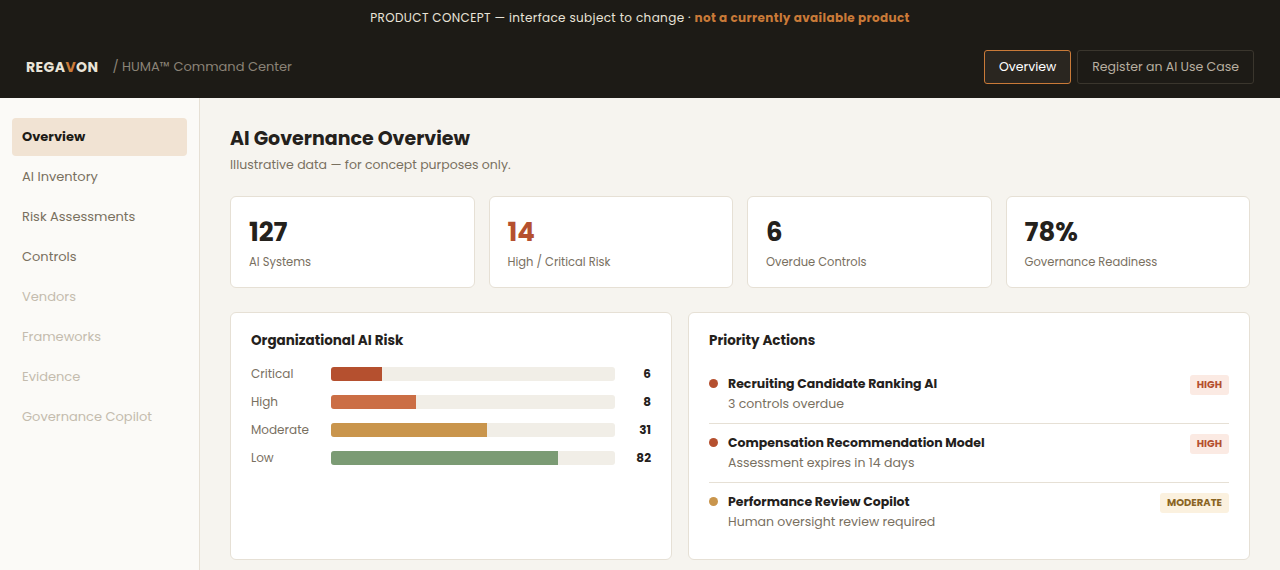
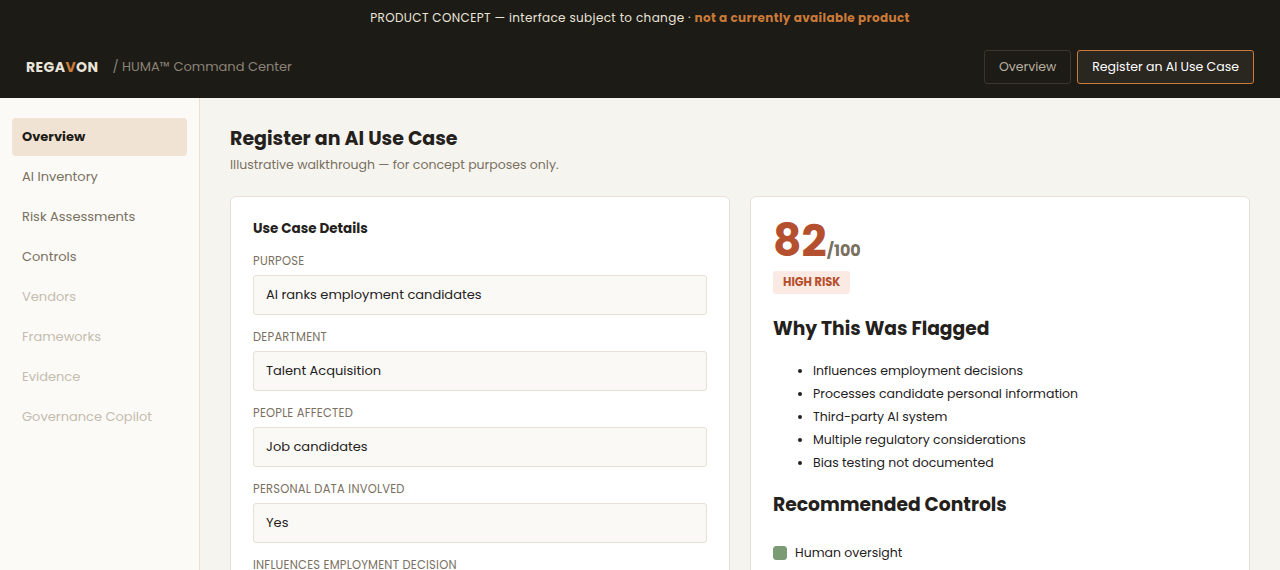
HUMA™ Command Center
A concept for the HUMA™ platform interface — where governance, risk and evidence come together in one operating view. Not a currently available product.
Agentic Governance Intelligence
HUMA™ Governance Agent
Governance intelligence, built into the system.
The Governance Agent helps translate governance requirements into structured action. It can guide users through AI use-case intake, surface relevant risks, identify decision-right considerations, suggest applicable controls, identify evidence requirements and surface governance gaps for human review.
The agent assists. Humans remain accountable.
Concept interface — envisioned as an intelligence layer within the HUMA™ operating environment, not a currently available product.
Governance Agent
Preliminary governance analysis
I identified three governance considerations for this use case.
01Risk Classification
Potential elevated workforce impact
02Decision Rights
Human approval recommended before consequential action
03Control Requirement
Document reviewer authority and override procedure
04Evidence Required
Approval record + decision log
The HUMA™ Governance System
Methodology
HUMA™ Methodology
Defines how governance works.
Operating Environment
Command Center
Operationalizes governance.
Agentic Intelligence
Governance Agent
Helps navigate and execute it.
Accountability
Human Review
Humans retain decision authority.
Free Resource
The HUMA™ Guide to Operational AI Governance
A practical introduction to building accountable AI governance — from use-case visibility and risk classification to decision rights, controls and evidence.
Govern AI. Keep accountability human.
Use HUMA™ to move from governance principles to an operating system for accountable AI.